Paying an employee a salary does not automatically make them exempt from overtime. This is the single most common classification mistake small businesses make - and it's the number one wage-and-hour claim filed against employers.
Getting this wrong can result in years of back pay, liquidated damages, attorney's fees, and penalties. Here's how to get it right.
What "Exempt" and "Non-Exempt" Mean
Under the Fair Labor Standards Act (FLSA), employees are either exempt or non-exempt from overtime requirements.
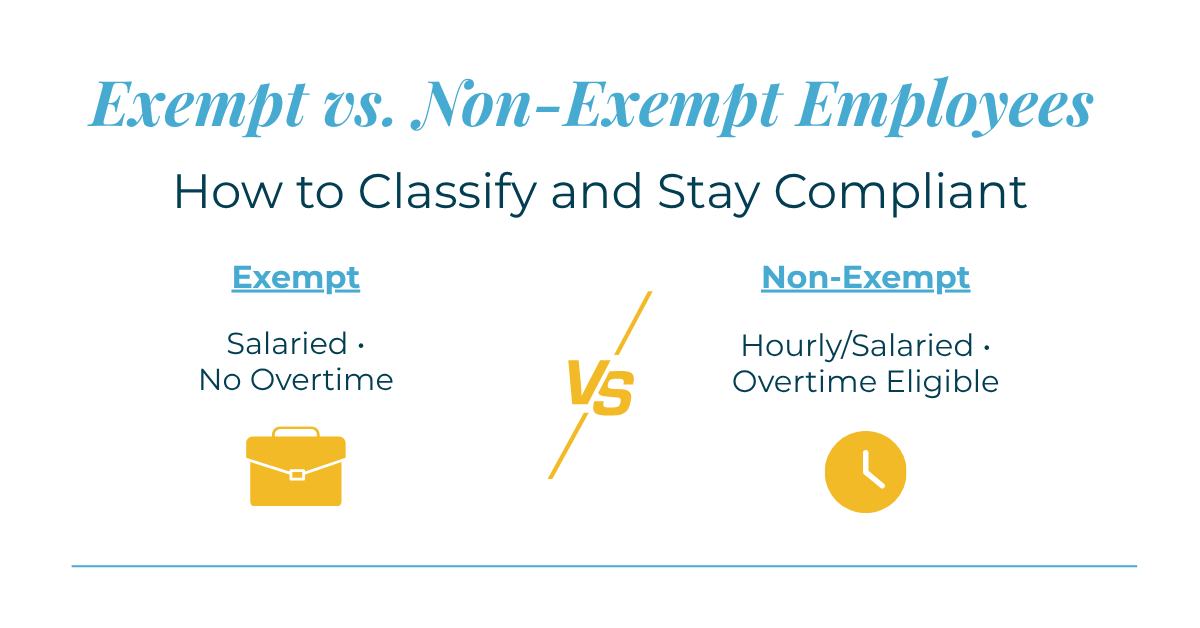
Non-exempt employees must be paid at least minimum wage for all hours worked and overtime (1.5x their regular rate) for every hour over 40 in a workweek.
Exempt employees are not entitled to overtime pay. They receive a fixed salary regardless of hours worked.
The distinction isn't about whether someone is salaried or hourly. Plenty of salaried employees are non-exempt and entitled to overtime.
The Three-Part Test
To qualify as exempt, an employee must meet all three criteria.
Salary Basis Test: The employee must be paid a predetermined, fixed salary that is not subject to reduction based on the quality or quantity of work. If you dock an exempt employee's pay because they left early on a Tuesday, you may be violating the salary basis test - and potentially converting them to non-exempt status.
Salary Level Test: The employee must earn at least the minimum salary threshold set by the DOL. This threshold is updated periodically - check the current rate at dol.gov. Some states have higher thresholds.
Duties Test: The employee must primarily perform exempt-level work. There are three main categories.
Executive: Manages the enterprise or a department, regularly directs the work of two or more employees, and has authority to hire/fire or make recommendations that carry weight.
Administrative: Performs office or non-manual work directly related to management or general business operations, and exercises independent judgment and discretion on matters of significance.
Professional: Performs work requiring advanced knowledge in a field of science or learning, customarily acquired through prolonged, specialized study.
There are additional exemptions for computer employees, outside sales employees, and highly compensated employees (earning above a higher threshold).
Common Misclassification Scenarios
An office manager who answers phones, orders supplies, and handles data entry - even though they're called a "manager," their duties likely don't meet the executive or administrative exemption.
A salaried employee earning $40,000 per year who regularly works 50-hour weeks - if they're below the salary threshold or their duties don't qualify, they're owed overtime for every hour past 40 each week.
A "supervisor" who spends most of their time doing the same work as their direct reports rather than managing - the title doesn't determine the classification; the actual duties do.
How to Audit Your Classifications
Review every salaried position. For each one, ask: does this employee meet all three parts of the test - salary basis, salary level, and duties? Don't rely on job titles. Look at what people actually do day to day. Document your analysis. If you're ever challenged, you'll want to show that you made a thoughtful, good-faith effort to classify correctly. When in doubt, classify as non-exempt. The risk of unpaid overtime claims far outweighs the cost of tracking hours and paying overtime when it's due.
What Happens When You Get It Wrong
An employee who should have been non-exempt can file a claim for up to two years of back overtime (three years if the violation was willful). The employer may owe the full unpaid overtime plus an equal amount in liquidated damages, plus the employee's attorney's fees. If multiple employees are misclassified, this can quickly become a class action.
Not Sure About Your Current Setup?
Classification audits are one of the most valuable things an HR partner can do for your business. If you haven't reviewed your exempt/non-exempt classifications recently, now is the time.