HR Glossary: Payroll, Benefits & Compliance Terms Every Business Owner Should Know
Pending Approval • Proof Read Required • BusinessOwner • HREducation • MossConsulting • HRHelp • SmallBusiness • Month 6 • HRTerms • PayrollTerms • HRGlossary • Sep 1, 2026, 8:00:06 AM • Author: Nicole Moss
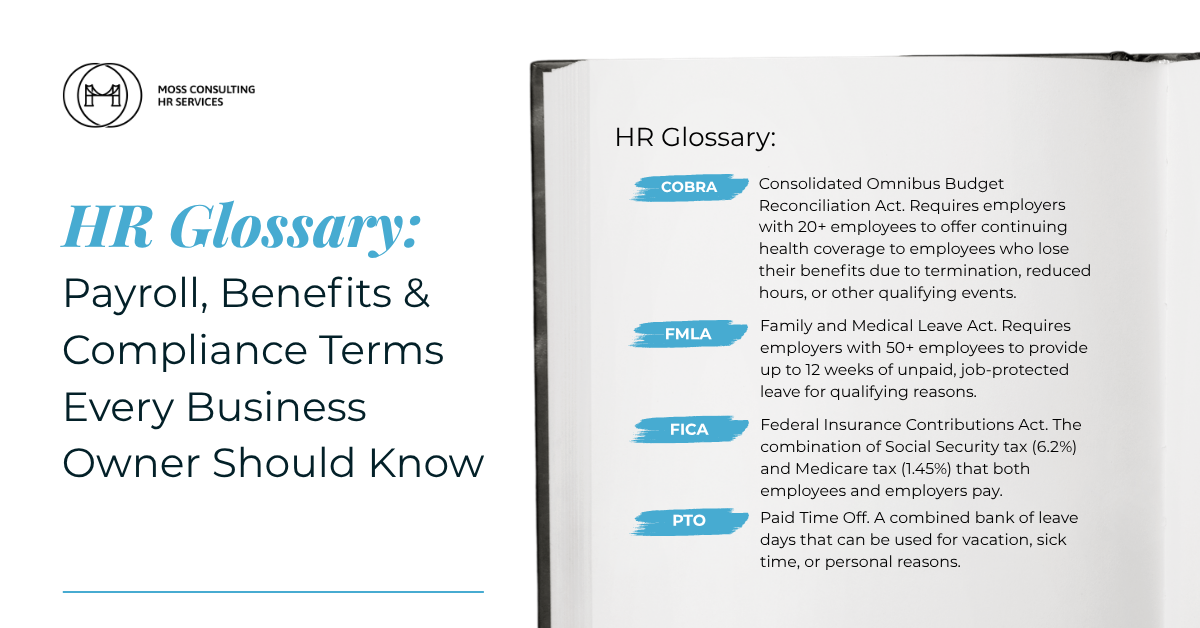
HR has no shortage of acronyms, tax forms, legal terms, and benefits jargon. If you run a business, you should not need a decoder ring every time payroll sends a notice or a benefits broker uses a new acronym. This glossary is your plain-English reference guide to some of the payroll, benefits, and compliance terms employers encounter most often. Bookmark it and come back whenever you need a quick definition.
Payroll & Paycheck Terms
1099-NEC: A tax form generally used to report nonemployee compensation paid in the course of a trade or business. For payments made in 2026, the federal reporting threshold is generally $2,000; the threshold is scheduled to be adjusted for inflation after 2026.
EIN: Employer Identification Number. This is a business's federal tax identification number issued by the IRS and commonly used for payroll, tax filings, banking, and other business functions.
FICA: Federal Insurance Contributions Act taxes. FICA includes Social Security and Medicare payroll taxes, with both employees and employers generally contributing.
FUTA: Federal Unemployment Tax Act. FUTA is a federal unemployment tax generally paid by employers to help fund unemployment programs; it is generally not withheld from employee wages.
Garnishment: A required payroll deduction made under a court order or other lawful withholding order to satisfy an obligation such as child support, taxes, or certain debts. Employers must follow the order as well as applicable federal and state limits.
Gross Pay: An employee's total earnings before taxes and other deductions are taken out.
Independent Contractor: A self-employed worker or business that provides services without being treated as an employee. Classification depends on the applicable legal tests and the actual working relationship - not simply what the parties call the relationship or whether the worker receives a 1099.
Net Pay: The amount an employee receives after taxes, benefit deductions, garnishments, and other applicable deductions are taken from gross pay. Also called take-home pay.
Overtime: Additional pay owed to non-exempt employees when overtime requirements are met. Under federal law, covered non-exempt employees are generally entitled to at least 1.5 times their regular rate for hours worked over 40 in a workweek; some states and localities have more protective rules.
Pay Date: The date employees actually receive their wages. The pay date may be several days after the pay period ends.
Pay Period: The span of time during which an employee earns the wages included in a paycheck - for example, weekly, biweekly, semimonthly, or monthly.
Post-Tax Deduction: A deduction taken after applicable payroll taxes have been calculated. Examples can include Roth 401(k) contributions and certain voluntary benefits or other deductions.
Pre-Tax Deduction: A payroll deduction taken before certain taxes are calculated, which may reduce taxable wages depending on the benefit and the tax involved. Common examples can include eligible health-plan premiums, traditional 401(k) contributions, and FSA contributions.
Regular Rate of Pay: The rate used under the Fair Labor Standards Act to calculate overtime for non-exempt employees. It is not always the same as an employee's base hourly rate because certain bonuses, differentials, and other compensation may need to be included.
Supplemental Wages: Compensation paid in addition to an employee's regular wages, such as certain bonuses, commissions, severance payments, or awards. Special federal withholding rules can apply.
SUTA: State unemployment tax, sometimes referred to by other state-specific names. Employer rates and wage bases vary by state and can be affected by factors such as the employer's unemployment claims history.
W-2: The annual wage and tax statement employers provide to employees and file with the government showing wages paid and taxes withheld during the year.
W-4: The federal form an employee completes so the employer can determine how much federal income tax to withhold from the employee's pay.
Withholding: Money an employer deducts from an employee's wages and sends to a tax authority on the employee's behalf, such as federal, state, or local income tax withholding.
Benefits & Health Insurance Terms
401(k) Match: An employer contribution tied to an employee's own 401(k) contribution, based on the formula in the plan. For example, a plan might match a percentage of what the employee contributes up to a stated limit.
ACA: Affordable Care Act. Among its many health coverage requirements, the ACA includes employer shared-responsibility rules for Applicable Large Employers - generally employers averaging at least 50 full-time employees, including full-time equivalents, during the prior year.
COBRA: Consolidated Omnibus Budget Reconciliation Act. Federal COBRA generally requires covered group health plans to offer temporary continuation coverage to qualified beneficiaries who lose coverage because of certain qualifying events. It generally applies to private-sector plans sponsored by employers with at least 20 employees, while some states have separate continuation laws for smaller employers.
Coinsurance: The percentage of the cost of a covered service that the covered person pays, such as 20%, after any applicable deductible requirements are met.
Copay: A fixed dollar amount a covered person pays for a plan-covered service, such as $30 for an office visit, depending on the plan.
Deductible: The amount a covered person generally pays for covered health care services before the health plan begins paying for many services. Some services may be covered before the deductible is met.
ERISA: Employee Retirement Income Security Act. A federal law that sets standards and participant protections for most voluntarily established retirement and health plans in the private sector, including disclosure, fiduciary, claims, and other requirements.
FSA: Flexible Spending Account. An employer-established arrangement that can allow employees to use pre-tax dollars for eligible expenses. Health FSAs are generally use-it-or-lose-it, although a plan may allow a permitted carryover or a grace period. Dependent Care FSAs are separate arrangements with different rules.
HDHP: High-Deductible Health Plan. In the HSA context, this is a health plan that meets specific IRS deductible and out-of-pocket requirements. A plan simply having a high deductible does not automatically mean an employee is HSA-eligible.
HRA: Health Reimbursement Arrangement. An employer-funded arrangement that reimburses eligible medical expenses up to limits set by the plan. Employees cannot fund an HRA through salary reductions, and the exact rules depend on the type of HRA offered.
HSA: Health Savings Account. A tax-advantaged account that eligible individuals can use for qualified medical expenses. HSA funds belong to the account holder, roll over from year to year, and may remain with the individual after changing jobs; eligibility rules apply.
Open Enrollment: The designated period when employees can enroll in, change, or decline certain benefit elections for the upcoming plan year without needing a special qualifying event.
Out-of-Pocket Maximum: The most a covered person generally has to pay in a plan year for covered in-network services that count toward the limit. After that limit is reached, the plan generally pays 100% of covered in-network benefits for the rest of the plan year. Premiums and certain other costs do not count toward the limit.
Premium: The amount paid for insurance coverage, usually on a monthly basis. For employer-sponsored benefits, the employer and employee may each pay a portion of the premium.
Qualifying Life Event (QLE): A major life change - such as marriage, birth or adoption of a child, or loss of other health coverage - that may allow an employee to make certain benefit changes outside the regular Open Enrollment period. The exact event and enrollment deadline depend on the plan and applicable rules.
Vesting: The process of earning ownership of employer contributions in certain retirement plans. An employee's own 401(k) deferrals are always 100% vested, while employer matching or other employer contributions may be subject to a vesting schedule depending on the plan.
Leave, Classification & Compliance Terms
ADA: Americans with Disabilities Act. Among other protections, Title I generally prohibits disability discrimination in employment and requires covered employers to provide reasonable accommodations to qualified individuals with disabilities unless doing so would cause undue hardship. It generally applies to employers with 15 or more employees.
At-Will Employment: The general employment principle, recognized in most U.S. states, that either the employer or employee may end the employment relationship at any time, with or without notice, as long as the reason is not unlawful and no contract or other legal restriction changes the rule.
Exempt: An employee who is not entitled to certain FLSA minimum wage and/or overtime protections because a specific exemption applies. For common white-collar exemptions, job duties and pay requirements matter. Being salaried or having “manager” in the job title does not automatically make an employee exempt.
FLSA: Fair Labor Standards Act. The federal wage-and-hour law that establishes rules such as minimum wage, overtime, child labor, and certain recordkeeping requirements for covered employers and employees.
FMLA: Family and Medical Leave Act. FMLA provides eligible employees of covered employers with job-protected leave for qualifying family and medical reasons. Eligibility generally includes 12 months of employment, at least 1,250 hours of service in the prior 12 months, and a worksite where the employer has at least 50 employees within 75 miles; other rules apply.
FTE: Full-Time Equivalent. A way of converting employee hours into a standardized headcount for certain legal or planning purposes. The calculation can vary depending on the rule being applied; for example, the ACA uses full-time equivalents when determining whether an employer is an Applicable Large Employer.
I-9: Form I-9, Employment Eligibility Verification. Employers use it to verify the identity and employment authorization of each new hire in the United States. Employees must complete Section 1 no later than their first day of employment, and employers generally must complete Section 2 within three business days after the employee begins work.
Non-Exempt: An employee who is covered by the FLSA's minimum wage and overtime protections. Covered non-exempt employees generally must receive overtime pay when federal or more protective state/local overtime rules are triggered.
OSHA: Occupational Safety and Health Administration. The federal agency that administers and enforces workplace safety and health requirements under the Occupational Safety and Health Act; approved state plans may administer their own programs.
PIP: Performance Improvement Plan. A formal document used to identify specific performance gaps, set clear expectations or goals, establish a review period, identify support or resources, and explain what may happen if performance does not improve.
PTO: Paid Time Off. Paid leave an employee can use under the employer's policy. Some employers combine vacation, sick, and personal time into one PTO bank, while others keep those categories separate.
Reasonable Accommodation: A change to a job, work environment, or customary process that enables a qualified individual with a disability to apply for a job, perform essential job functions, or enjoy equal employment opportunities. Whether an accommodation is reasonable depends on the circumstances.
Title VII: Title VII of the Civil Rights Act of 1964. A federal law that generally prohibits employment discrimination based on race, color, religion, sex, or national origin. It generally applies to employers with 15 or more employees, and other federal, state, or local protections may also apply.
Workers' Compensation: A state-regulated system that can provide medical and wage-replacement benefits for qualifying work-related injuries or illnesses. Requirements vary by state; most states require coverage in many circumstances, while Texas generally does not require most private employers to carry workers' compensation insurance.
This glossary will continue to grow.
If there is an HR, payroll, benefits, or compliance term you keep seeing and still have to Google every time, send it our way - we may add it to the list.
We're Here to Help