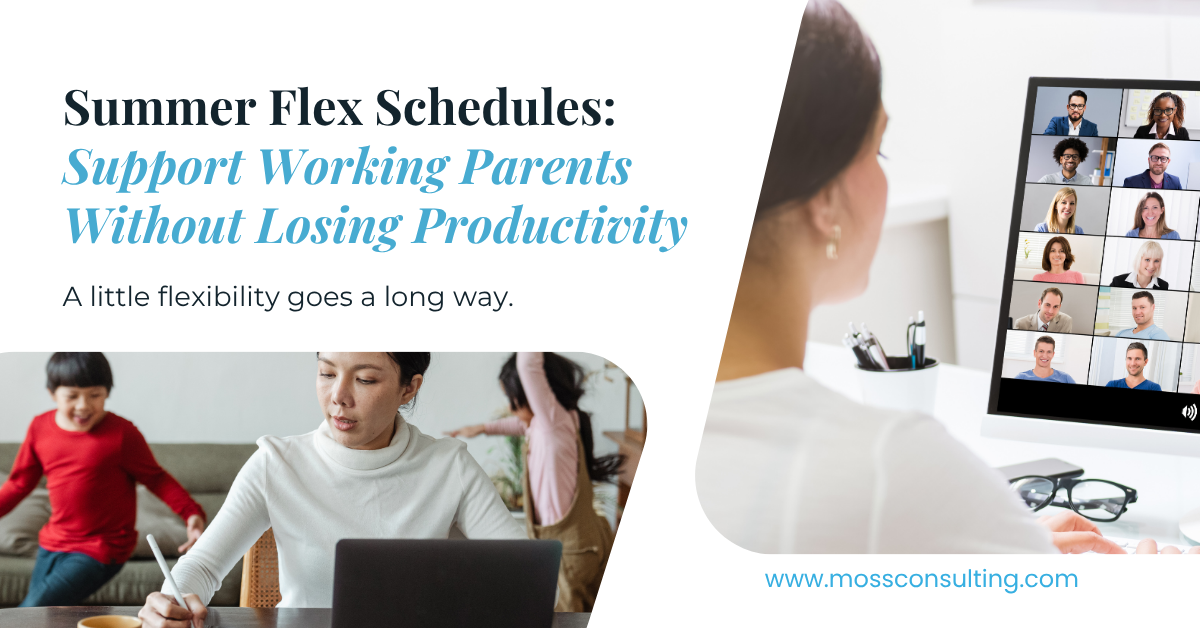
Every summer, the same scenario plays out at small businesses across the country. School lets out. Camps have gaps. Childcare costs skyrocket. And your working parents are quietly stressed, distracted, and trying to hold everything together.
Here's what many business owners miss: a little flexibility now prevents a lot of turnover later. The cost of replacing an employee - recruiting, hiring, training, lost productivity - typically runs 50% to 200% of their annual salary. A summer flex schedule costs you virtually nothing.
What "Flex" Actually Means
Flex scheduling isn't a free-for-all. It's a structured adjustment to when, where, or how employees work during a defined period. Here are the most common options.
Adjusted Hours: Instead of 8-5, an employee might work 7-4 or 9-6 to accommodate school pickup or camp dropoff. The total hours stay the same; only the timing shifts.
Compressed Workweeks: Employees work longer days in exchange for a shorter week - four 10-hour days instead of five 8-hour days, for example. This gives employees a full weekday off without reducing their hours.
Remote Fridays: Allowing employees to work from home one day per week - especially Fridays during summer - reduces commute stress and gives parents more flexibility to handle logistics.
Hybrid Arrangements: A combination of in-office and remote days tailored to the team's needs.
How to Implement It Without Chaos
Define what you're offering. Be specific about which types of flex are available and for how long. "Summer flex runs from June 1 through August 31. Eligible employees may request adjusted start/end times or one remote day per week."
Set clear expectations. Flex scheduling changes when people work, not whether they work. Core hours of availability (e.g., 10 a.m. to 3 p.m.), response time expectations, and meeting attendance policies should be clearly communicated.
Apply it consistently. If flex is available, it should be available to all eligible employees - not just the ones who ask. Selective application creates resentment and legal risk.
Get manager buy-in. Front-line managers make or break flexible work policies. If a manager frowns every time someone leaves at 4 p.m., the policy doesn't actually work. Train managers to evaluate output, not desk time.
Measure results, not just hours. During the flex period, track productivity, deadlines met, and team satisfaction. You may find that output actually improves - multiple studies show that flexibility increases focus and reduces burnout.
Revisit in September. After summer ends, debrief. What worked? What didn't? Should any adjustments become permanent? The best flex policies evolve based on real experience.
Addressing Common Concerns
"It's not fair to employees without kids." Frame flex scheduling as a benefit available to everyone, not just parents. Employees without children may want flexibility for other reasons - continuing education, elder care, personal wellbeing. A universal policy avoids the perception of favoritism.
"We can't do this with our type of business." Some roles genuinely require on-site, fixed-schedule coverage. In those cases, consider offering different forms of flexibility: shift swapping, compressed schedules, or additional PTO during summer months. Something is always better than nothing.
"People will take advantage." This concern is almost always unfounded. When expectations are clear and output is measured, most employees treat flexibility as a privilege they don't want to lose.
The Business Case
Supporting working parents isn't just the right thing to do - it's a strategic advantage. Companies that offer flexibility see higher retention (especially among experienced employees), stronger engagement and morale, easier recruiting, and reduced absenteeism.
The business that helps its team navigate summer doesn't just survive the season. It earns loyalty that lasts long after school starts again.
Want help designing a flex schedule policy for your team? We can build one that fits your business model and keeps you compliant.
mossconsulting.com/book-a-free-consultation