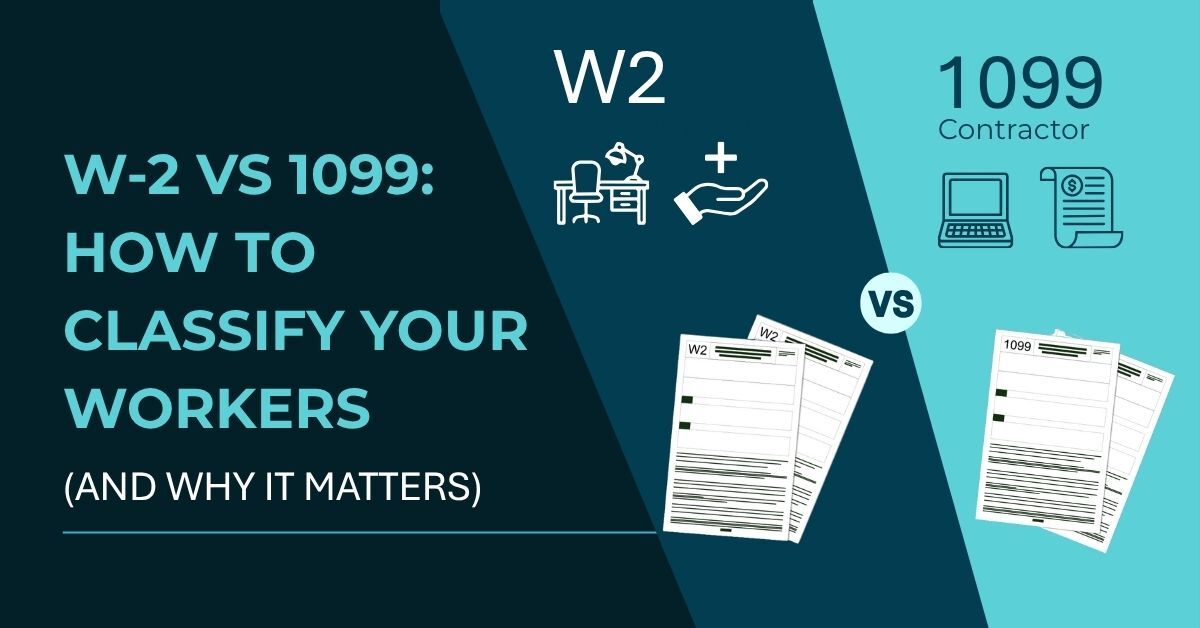
W-2 vs 1099: How to Classify Your Workers (and Why It Matters)
If you pay people to do work for your business, one of the most important decisions you'll make - and one of the most common mistakes we see - is how you classify them.
Are they an employee (W-2)? Or an independent contractor (1099)?
This isn't just a paperwork distinction. Getting it wrong can trigger back taxes, penalties, lawsuits, and even criminal liability in extreme cases. The IRS, the Department of Labor, and state agencies are all actively increasing enforcement on worker misclassification.
Here's a quick guide you can download and reference easily:
For more details on each, read below.
Why Classification Matters
When someone is classified as a W-2 employee, you're responsible for withholding income taxes, paying your share of Social Security and Medicare (FICA), providing workers' compensation insurance, paying unemployment taxes (FUTA and SUTA), and complying with wage-and-hour laws like overtime and minimum wage.
When someone is classified as a 1099 independent contractor, none of those obligations apply. The contractor handles their own taxes, insurance, and benefits.
That cost difference is significant - which is exactly why some businesses are tempted to classify workers as 1099 even when they shouldn't.
The IRS Test: How to Tell the Difference
The IRS looks at three categories to determine whether a worker is an employee or contractor:
Behavioral Control: Do you control what the worker does and how they do it? If you dictate their schedule, methods, tools, and processes, that points toward employee status.
Financial Control: Do you control the business aspects of the work? If you set their pay rate, reimburse expenses, and provide all the tools and materials, that points toward employee status. Contractors typically invest in their own equipment and can profit or lose money on a job.
Relationship Type: Is there a written contract? Are there employee-type benefits? Is the work a key part of your business? The more the relationship looks like ongoing, integral work with benefits and no end date, the more it looks like employment.
There's no single factor that decides it. The IRS looks at the full picture. But here's a good rule of thumb:
If you control what gets done AND how it gets done, that's probably an employee.
If you define the result but the worker controls the process, that's closer to a contractor.
Common Misclassification Scenarios
A "freelancer" who works 40 hours a week exclusively for your company, uses your equipment, follows your schedule, and reports to a manager - that's an employee, regardless of what the contract says.
A graphic designer who works for multiple clients, sets their own hours, uses their own software, and delivers finished work by a deadline - that's typically a contractor.
The title you put on the relationship doesn't determine the classification. The actual working relationship does.
What Happens If You Get It Wrong
The penalties for misclassification can include back payment of all employment taxes you should have withheld, penalties and interest on unpaid taxes, liability for employee benefits the worker should have received, exposure to wage-and-hour claims for overtime and minimum wage, and potential state-level fines and lawsuits.
In some states, intentional misclassification carries criminal penalties.
How to Protect Your Business
First, audit your current workforce. Look at every 1099 relationship and honestly assess whether it passes the IRS test.
Second, document the nature of each relationship. A well-written contract helps, but it won't override the actual facts of how the work is performed.
Third, when in doubt, classify as an employee. The cost of paying employment taxes is always less than the cost of a misclassification penalty.
Finally, get help if you're not sure. This is one of the highest-risk compliance areas for small businesses, and it's worth getting right.
Need a Second Opinion?
If you're working with contractors and you're not 100% confident they're classified correctly, let's talk. A quick review now is a lot cheaper than a problem later.
mossconsulting.com/book-a-free-consultation